Scenario 22B
Overview
A short, action-oriented Half-Life 2 level, where the player is tasked to defend a rebel base from a Combine attack, all happening inside a Combine-run simulation!
Play it on the Steam Workshop
Design Goals
-
Push my scripting skills to their limits
-
Big focus on encounter design, cinematicity, and creating drama
-
Base decisions on intentional design choices and extensive playtesting
Constraints
-
Made for the Level Design Jam 11 hosted by Steve Lee
-
Theme: illusion
-
Plan to keep working on the project after the jam, iterating and polishing it beyond the deadline
Video Breakdown
This is a full video breakdown where I talk more in-depth about all of my main design decisions throughout the level.
Iterations & Final Result
Below are the main iterations for each key area, presented in the order the player experiences them.
Dormitories
Iterations here focused on lowering scale.
The area felt too large, and many playtesters missed the opening event where the citizen gets killed.
I lowered the ceiling and removed two dormitory sections, making the player spawn closer to the action.
The citizen now dies directly in front of the player’s window. After this change, every playtester noticed the event.


Office Hall
I significantly reduced the arena size and focused iterations on cover placement, player and enemy flow.
The flares were actually added only in the last iteration. This idea emerged while working on lighting and ended up enhancing the tension and giving novelty to the fight.
Originally, this section also contained a simulation anomaly using a looping sliding door. Playtesters interpreted it as a bug rather than a feature. I tried iterating on it several times, but was never sufficiently satisfied with it so I removed it and replaced it with system messages spread throughout the level.


Corridor
Many playtesters missed an optional but important moment here, where a rebel with an RPG salutes the player through a window, foreshadowing his presence later on in the level.
I added a downward slope to block the player’s line of sight, improved the window’s framing, lighting, and trigger placement.
After these changes, playtesters consistently noticed the event.


Stairwell
I initially removed one floor because the rappelling soldiers took too long to reach the player, and added some cover.
Later, I reintroduced it as an upper path, creating a meaningful choice: go up for high ground or go down to secure the AR2 that one of the soldiers drops.
I also retimed and reframed the rappelling event so players would not miss it.
In the final iteration, I moved one soldier to the rooftop instead of rappelling, creating a dynamic threat balance with stronger pressure from below and lighter pressure from above.


Sewers
This section started as a purely narrative space with a second simulation anomaly, but playtesters did not understand its meaning just like in the hall.
After removing the anomaly, I redesigned the area entirely into an encounter where the Combine were already present inside the space and set up a defensive position with a turret the player has to get to.
This shifted the player's role from defending to pushing forward.


Elevator
After reworking the sewer encounter, I realized I could carry the turret forward into the next section.
This led to the elevator shaft sequence, where the player rides the elevator while using the turret.
Playtesters responded extremely well to this section, often citing it as their favorite.
Since players liked the section a lot, I decided to expand it slightly: I increased the amount of enemy spawning to add drama and impact to the moment and added a narrative set piece half-way through the ascent where players could influence the outcome using the turret as help.


Rooftop
This was the most iterated section of the entire level and went through one major redesign.
Initially, playtesters felt the space lacked cover and that combat distances were too long, forcing them to rely almost exclusively on the AR2.
I reduced the arena size, restructured each wave, and scripted the second wave of soldiers to destroy the turret (now part of the encounter) to avoid trivializing later phases.
In the final iteration, I opened the space visually and rewarded the player with a large vista over City 17.
Each wave now focuses on a different combat dynamic, ranging from long-range combat to kiting.
In earlier iterations, the final boss was actually a gunship, but I wanted to experiment replacing it with a strider, which offered more interesting scripting opportunities and a stronger final showdown.
Playtesters consistently preferred this version, so I decided to keep it as the final ending.


My Process
Text-first
I opened a simple notepad file and divided it roughly like this:
Constraints
I wrote down external constraints from the jam and internal constraints I set for myself.
Narrative
I value narrative a lot. I like when players feel immersed and understand the impact of their actions and the world around them.
I always try to answer the basic questions: why the player is here, what is happening, where they are, and how they are involved.

Ideas
Any idea I get at any time goes here.
Sequence
The full level flow from start to finish.
I describe player action and set pieces without focusing too much on layout or visual theme.

A couple examples of my text document at the end of development
Sketch
Scribbles
While writing the sequence, I love to very roughly sketch down interesting situations I come up with on text, to try to visualize them. This includes layout ideas, encounters, anything really.
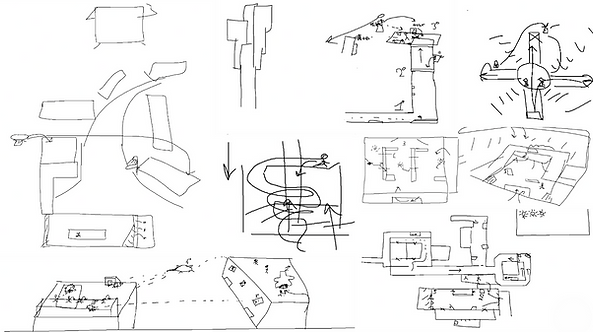
A collection of some of my scribbles for this level
Rough Layout
A simple top-down layout using basic shapes in tools like PowerPoint. This helps me visualize the level’s structure from start to finish; knowing how spaces connect or loop back into each other, if that’s the case.

The rough layout I ended up with
Tension Graph

References
.jpg)
Blockout
I blocked out spaces using simple geometry and dev textures and started scripting encounters.
If I come up with an idea that might be risky or unclear to implement, I test it in a separate test map before touching the main level.
This phase is very iterative. I constantly go back to the text document, add ideas, remove others, and sketch new solutions.
Editor

Two images of my test levels

Closing Thoughts
Overall, I’m very satisfied with the result.
One of my main goals was to give players meaningful choice in every encounter, and I was glad to see that each player developed their own way of approaching each fight.
The main things I would revisit are emphasizing greater variety between encounters, possibly expanding the turret section, and putting more focus on the layout. Everything ended up a bit too “boxy” for my liking. That’s partly a limitation of Hammer, of course, but still something I’d like to improve.
I eventually published the map on the Steam Workshop, and it received a very positive response.
At the time of writing, it has over 2000 downloads and sits at 94% positive reviews!